Showing posts with label "fairytale writers". Show all posts

Friday, January 31, 2014

fairytale friday with fairy tale about the wicker chair


Fairy Tale About The Wicker Chair
written by Hermann Hesse

     A young man sat in his solitary attic.  His greatest desire was to become a painter, but first he had to overcome quite a few obstacles.  To begin with, he lived peacefully in his attic, grew somewhat older, and became accustomed to sitting for hours in front of a small mirror and experimenting with painting self-portraits.  He had already filled an entire notebook with such sketches, and he was very satisfied with some of them.
     "Considering htat I never went to art school," he said to himself, "this sketch has turned out rather well.  And that is an interesting wrinkle there next to the nose.  You can see that I'm something of a thinker or something similar.  I need only to lower the corner of the mouth a little.  Then I'd have my own special expression, quite melancholy."
     But when he reexamined the sketches sometime later, most of them no longer pleased him.  That was irritating, but he concluded from this that he had made progress and was now placing greater demands himself.
     The young man did not live in the most desirable attic, nor did he have a very agreeable relationship with the things lying and standing around this attic.  However, it was not a bad relationship.  He hardly noticed the objects and was not very familiar with them.
     Whenever he failed to paint a good self-portrait, he read for a while from books and learned what had happened to other people who, like him, had begun as modest and completely unknown painters and then had become very famous.  He liked to read such books and read his own future in them.
     So one day he was again somewhat sullen and depressed and sat at home reading about a very famous Dutch painter.  He read that this painter had been possessed by a true passion.  Indeed, he was frenetic and completely governed by a drive to become a good painter.  The young man found that he had many traits in common with this Dutch painter.  As he read further, he also discovered many that did not exactly fit him.  Among other things he read that whenever the Dutchman had not been able to paint outside due to bad weather, he had painted everything inside, even the tiniest object that met his eyes, unflinchingly and passionately.  One time he had painted a pair of old wooden shoes, and another time an old crooked chair--a coarse, rough kitchen and peasant chair made out of ordinary wood, with a seat woven out of straw, quite tattered.  The painter had painted this chair, which nobody certainly would have considered worth a glance, with so much love and dedication and with so much passion and devotion that it became one of his most beautiful pictures.  The painter's biographer found many wonderful and appropriately touching words to say about this painted straw chair.


     Here the reader stopped and contemplated.  That was something new that he had to try.  He decided immediately--for he was a young man who made very rash decisions--to imitate the example of this great master and to try this way to greatness.
     He looked around in his attic and realized that he had actually not paid much attention to the things among which he lived.  He did not find a crooked chair with a set woven out of straw anywhere; nor were there any wooden shoes.  Therefore he was momentarily dejected and despondent, and he almost felt discouraged, as he had often felt whenever he read about the lives of great men.  At those times he realized that all the little indicators and remarkable coincidences that had played roles in the lives of the others had not become apparent in his life, and he would wait in vain for them to appear.  However, he soon pulled himself together and realized that it was now his task to be persistent and pursue his difficult path to fame.  He examined all the objects in his little room and discovered a wicker chair that could serve him very well as a model.
     He pulled the chair closer with his foot, sharpened his art pencil, took his sketch pad on his knee, and began to draw.  After a couple of light first strokes, he seemed tohave captured the form sufficiently, and now he inked in the thick outlines with a few firm and powerful strokes.  A deep triangular shadow in a corner attracted him, and he painted it full of strength, and so he continued until something began to disturb him.
     He worked a little while longer.  Then he held the sketch pad away from himself and examined his sketch carefully.  His very first glance told him that he had completely failed to capture the wicker chair.

John Foster Dyess

     Angrily he drew a new line into the sketch and fixed his eyes grimly on the chair.  The sketch was still not right.  It made him mad.
     "You demonic wicker chair!" he screamed violently.  "I've never seen a beast as moody as you are!"
     The chair cracked a little and said with equanimity, "Yes, take a look at me!  I am as I am, and I won't change myself anymore."
     The painter kicked it with his toe.  The chair swerved backward to avoid the kick and now looked completely different.
     "You dumb chair!" the young man exclaimed.  "Everything is crooked and wrong about you."
     The wicker chair smiled a little and said softly, "That's what's called perspective, young man."
     The painter jumped up.  "Perspective!" he yelled furiously.  "Now this clown of a chair comes and wants to play schoolteacher.  Perspective is my affair, not yours.  Remember that!"
     The chair said nothing more.  The painter stomped loudly back and forth a few times until someone began pounding beneath the floor with a cane.  An elderly man, a scholar, lived under him, and he could not bear the noise.
     The young man sat down and looked at his last self-portrait.  But it did not please him.  He found that he looked more handsome and interesting in reality, and that was the truth.
     Now he wanted to read his book again, but there was more in the book about the Dutch straw chair, which irritated him.  He now felt that the writer had really made much too much of it, and after all...
     The young man looked for his artist's hat and decided to go out.  He remembered that he had long ago been struck by the fact that painting was not very fulfilling.  One had nothing but bother and disappointments, and in the end even the best painter in the world could portray only the simple surface of objects.  For a man who loved the profound aspects of life, it was no profession for him in the long run.  And once more he seriously thought, as he had done many times, about following an even earlier inclination and becoming a writer instead of a painter.  The wicker chair remained behind in the attic.  It was sorry that its young master had gone.  It had hoped that a decent relationship could finally develop between the two of them.  It would have liked at times to speak a word, and it knew that it certainly had many valuable things to teach a young man.  But unfortunately nothing ever came of this.

James Gulliver Hancock
    

Friday, December 20, 2013

fairytale friday with the witches' excursion


The Witches' Excursion
from Legends of Irish Witches and Fairies
written by Patrick Kennedy 1866-1870
Shemus Rua was awakened from his sleep one night by noises in his kitchen.  Stealing to the door, he saw half a dozen old women, sitting round the fire, jesting, and laughing, his own old housekeeper, Madge, quite frisky and gay, helping her sister crones to cheering glasses of punch.  He began to admire the impudence and imprudence of Madge, displayed in the invitation and the riot, but recollected on the instant her officiousness in urging him to take a comfrotable posset, which she had brought to his bedside just before he fell asleep.  Had he drunk it he would have been just now deaf to the witches' glee.  He heard and saw them drink his health in such a mocking style as nearly to tempt him to charge them, besom in hand, but he restrained himself.  The jug being emptied, one of them cried out, "It is time to be gone," and at the same moment, putting on a red cap, she added
By yarrow and rue,
And my red cap too,
Hie over to England.


Making use of a twig which she held in her hand as a steed, she gracefully soared up the chimney, and was rapidly followed by the rest.  But when it came to the housekeeper's turn, Shemus interposed.  "By your leave, ma'am!" said he, snatching twig and cap, "Ah, you desateful ould crocodile!  If I find you here on my return, there'll be wigs on the green."
By yarrow and rue,
And my red cap too,
Hie over to England.
The words were not out of his mouth when he was soaring above the ridge-pole, and swiftly ploughing the air.  He was careful to speak no word (being somewhat conversant in witch lore), as the result would be a tumble, and immediate return of the expedition.  In a very short time they had crossed the Wicklow hills, the Irish Sea, and the Welsh mountains, and were charging at whirlwind speed the halldoor of a castle.  Shemus, only for the company in which he found himself, would have cried out for pardon, expecting to be mummy against the hard oak door in a moment, but all bewildered he found himself passing through the keyhole, along a passage, down a flight of steps, and through a cellar door keyhole, before he could form any clear idea of his situation.
Waking to the full consciousness of his postion, he found himself sitting on a stillion, plenty of lights glimmering round, and he and his companions, nobbing and drinking helths as jovially and recklessly as if the liquor was honestly come by, and they were sitting in Shemus's own kitchen.  The red birredh had assimilated Shemus's nature for the time being to that of his unholy companions.  The heady liquors soon got in their brains, and a period of unconsciousness succeeded the ecstasy, the headache, the turning round the barrels, and the scattered sight of poor Shemus.  He woke up under the impression of being roughly seized, and shaken and dragged upstairs, and subjected to a disagreeable examination by the lord of the castle, in his state parlour.  There was much derision and laughter among the whole company, gentle and simple, on hearing Shemus's explanation; and as the thing occurred in the dark ages, the unlucky Leinsterman was sentenced to be hung as soon as the gallows could be prepared for the occasion.
The poor Hibernian was in the cart proceeding on his last journey, with a label upon his back, and another on his breast, announcing him as the remorseless villain who for the last month had been draining casks in my lord's vaults every night.  He was striving to say a prayer, when he was surprised to hear himself addressed by his name, and in his native tongue, by an old woman in the crowd.  "Ach, Shemus, alanna! is going to die, you are in a strange place, without your cappeen dearg!"  These words infused hope and courage into the victim's heart.  He turned to the lord, and humbly asked leave to die in his red cap, which he supposed had dropped from his head in the vault.  A servant was sent for the headpiece, and Shemus felt lively hope warming his heart while placing it on his head.  On the platform he was graciously allowed to address the spectators, which he proceeded to do in the usual formula composed for the benefit of flying stationers:  "Good people all, a warning take by me;" but when he had finished the line, "My parents reared me tenderly," he unexpectedly added,  
By yarrow and rue,
And my red cap too,
Hie over to England.
and the disappointed spectators saw him shoot up obliquely through the air in the style of a skyrocket that had missed its aim.  
It is said that the lord took the circumstance muchto heart, and never afterwards hung a man for twenty-four hours after his offence.


Friday, December 13, 2013

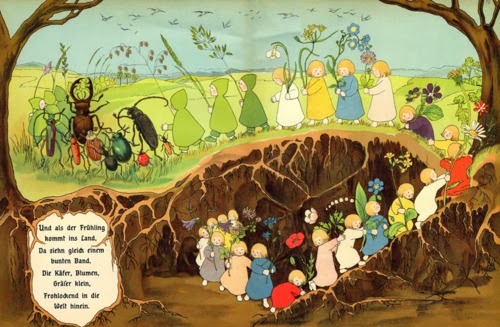
fairytale friday with when the root children wake up


When the Root Children Wake Up
by Helen Dean Fish, Copyright, The Green Tiger Press, Inc., 1988
based on Etwas von der Wurzelkindern originally published in 1906

All Winter long the trees are bare, the wind in cold and fields are empty.
But very early in the Spring the Sun begins to grow warmer, the air softer and the sky bluer.  And boys and girls grow happier though they cannot tell just why.
Down underground something is happening.
Something secret and wonderful.
The root children who have been sleeping soundly all Winter are awakened by the Earth Mother.  She comes with her candle and her little firefly helpers to tell them they must be up and at work for it will soon be Spring.  They are very sleepy at first but soon begin to stretch and open their eyes and be glad that it is time to wake.


Wide awake at last, in their root house, the root children work busily on their new Spring dresses.  Each chooses the color she loves best--violet, yellow, blue, white, orange or red--and with needle, thread and thimble, sews happily till her work is done.
Above them, in the little village by the sea, the sky and water are growing bluer.

The root children take their dresses to show to the good Earth Mother, where she sits comfortably with her tea and her knitting.  Her busy ant helpers are about her.  She is pleased when she sees how well each root child has made her Spring dress.


It is time to be ready, for above them the ice on the little brook has melted and the water is slipping merrily over its pebbles.  In the barns the sheep and lambs feel the Spring air and wish to be in the green fields again.

While the little root girls are sewing Spring dresses, the root boys are busy with their share in making ready for Spring.  They wake up the sleeping insect--the beetles, grasshoppers, ladybugs, crickets, bumble bees, fireflies and june bugs.  They sponge them and brush them and paint their shells with bright Spring colors, while the filds over their heads are growing greener and the leef buds on the trees are swelling in the warm Spring air.


Then, when all is ready, Spring comes!
First the meadow grasses fare out over the countryside, green and lovely, waving in the wind.
Then the busy insects, eager to do their work in fields and woods and gardens, singing and humming and leaping.
Next the good grains push their heads above the ground.
Last, and most beautiful of all, come the flowers in a sweet and gay procession--snowdrop and stargrass, forget me not and aster, violet, dandelion, columbine, daisy and primrose; hepatica, lily, anemone and poppy, cornflower, clover and bluebell.
Out they troop joyfully, out of their earth home into the lovely world, where birds fly in the blue sky above green meadows.


The flower children scatter far and wide.  Some choose the deep woods, and as lillies of the valley and violets, bloom shyly under the trees.  Gay butterflies hover above them, scarlet mushrooms brighten the moss, and the slow snail creeps out of his house to play, glad that Spring has come again.  


Others hurry to the pond side and play there all day long, making it gay with water lillies, forget me nots and wild iris.  Spiders spin lovely webs that shine in the sun.  The reeds wave and rustle in the passing wind, and dragon flies dart hither and thither.

Still others play in the meadows, dancing merrily, under the sunny sky with the beetles and butterflies, to the music of grasshoppers' chirping and bees' humming.  Each little root child is now a poppy or a daisy, a cornflower or a bluebell, or a graceful yarrow flower.


And so they play all Summer long, until a day comes when the air is chill and the leaves, turned red and gold and brown, are fluttering down to earth.  The flower children come running over hills and valleys, from meadows, woods, and brookside, back to the Earth Mother, who welcomes them to their warm earth home to rest and sleep the cold Winter through, until Spring comes again next year!


Wednesday, August 1, 2012

little ida's flowers conclusion


Little Ida's Flowers by Arthur Szyk


Little Ada's Flowers illustrated by Arthur Rackham

Little Ida's Flowers by Arthur Szyk


But the flowers did not come, and the music continued to play

beautifully; then she could not bear it any longer, for it was too pretty;
she crept out of her little bed, and went quietly to the door,
and looked into the room. Oh, how splendid it was, what she saw!
 
There was no nightlamp burning, but still it was quite light;
the moon shone through the window into the middle of the floor;
it was almost like day. All the hyacinths and tulips stood in two long
rows on the floor; there were none at all left at the window.
There stood the empty flowerpots. On the floor all the flowers were
dancing very gracefully round each other, making a perfect chain,
and holding each other by the long green leaves as they swung round.
But at the piano sat a great yellow lily, which little Ida had certainly
seen in summer, for she remembered how the student had said,
'How like that one is to Miss Lina.'
Then he had been laughed at by all; but now it seemed really
to little Ida as if the long yellow flower looked like the young lady;
and it had just her manners in playing—sometimes bending its long,
yellow face to one side, sometimes to the other, and nodding in tune
to the charming music!
No one noticed little Ida. Then she saw a great blue crocus hop
into the middle of the table, where the toys stood, and go to the doll's
bed and pull the curtains aside; there lay the sick flowers,
but they got up directly, and nodded to the others, to say that they
wanted to dance too. The old chimney sweep doll, whose under lip
was broken off, stood up and bowed to the pretty flowers: these did
not look at all ill now; they jumped down among the others,
and were very merry.
Then it seemed as if something fell down from the table.
Ida looked that way. It was the Shrovetide birch rod which was
jumping down! it seemed almost as if it belonged to the flowers.
At any rate it was very neat; and a little wax doll, with just such a
broad hat on its head as the councillor wore, sat upon it.
The birch rod hopped about among the flowers on its three red legs,
and stamped quite loud, for it was dancing the mazurka; and the
other flowers could not manage that dance, because they were
too light, and unable to stamp like that.
The wax doll on the birch rod all at once became quite great
and long, turned itself over the paper flowers, and said,
'How can one put such things in a child's head?
Those are stupid fancies!' and then the wax doll was exactly like
the councillor with the broad hat, and looked just as yellow
and cross as he. But the paper flowers hit him on his thin legs,
and then he shrank up again, and became quite a little wax doll.
That was very amusing to see; and little Ida could not
restrain her laughter. The birch rod went on dancing, and the councillor
was obliged to dance too; it was no use whether he might make  
himself great and long, or remained the little yellow wax doll with the
big black hat. Then the other flowers put in a good word for him,
especially those who had lain in the doll's bed, and then the birch rod
gave over. At the same moment there was a loud knocking at the
drawer, inside where Ida's doll, Sophy, lay with many other toys.
The chimney sweep ran to the edge of the table, lay flat down
on his stomach, and began to pull the drawer out a little.
Then Sophy raised herself, and looked round quite astonished.

'There must be a ball here,' said she; 'why did nobody tell me?'
'Will you dance with me?' asked the chimney sweep.
'You are a nice sort of fellow to dance!' she replied,
and turned her back upon him.

Then she seated herself upon the drawer, and thought that one
of the flowers would come and ask her; but not one of them came.
Then she coughed, 'Hem! hem! hem!' but for all that not one came.
The chimney sweep now danced all alone, and that
was not at all so bad.
As none of the flowers seemed to notice Sophy, she let herself fall
down from the drawer straight upon the floor,
so that there was a great noise. The flowers now all came running up,
to ask if she had not hurt herself; and they were all very polite to her,
especially the flowers that had lain in her bed. But she had not hurt
herself at all; and Ida's flowers all thanked her for the nice bed,
and were kind to her, took her into the middle of the floor,
where the moon shone in, and danced with her; and all the other
flowers formed a circle round her. Now Sophy was glad, and said
they might keep her bed; she did not at all mind lying in the drawer.

But the flowers said, 'We thank you heartily, but we cannot live so
long. Tomorrow we shall be quite dead. But tell little Ida she is
to bury us out in the garden, where the canary lies; then we shall
wake up again in summer, and be far more beautiful.'

'No, you must not die,' said Sophy; and she kissed the flowers.

At that moment the door opened, and a great number of splendid
flowers came dancing in. Ida could not imagine whence they
had come; these must certainly all be flowers from the king's
castle yonder. First of all came two glorious roses, and they had
little gold crowns on; they were a king and a queen. Then came
the prettiest stocks and carnations; and they bowed in all directions.
They had music with them. Great poppies and peonies blew upon
peapods till they were quite red in the face. The blue hyacinths
and the little white snowdrops rang just as if they had bells on them.
That was wonderful music! Then came many other flowers,
and danced all together; the blue violets and the pink primroses,
daisies and the lilies of the valley. And all the flowers kissed
one another. It was beautiful to look at!

At last the flowers wished one another good night; then little Ida,
too, crept to bed, where she dreamed of all she had seen.
When she rose next morning, she went quickly to the little table,
to see if the flowers were still there. She drew aside the curtains
of the little bed; there were they all, but they were quite faded,
far more than yesterday. Sophy was lying in the drawer where Ida
had laid her; she looked very sleepy.

"Do you remember what you were to say to me!" asked little Ida.
But Sophy looked quite stupid, and did not say a single word.
"You are not good at all!" said Ida. "And yet they all danced with you."

Then she took a little paper box, on which were painted
beautiful birds, and opened it, and laid the dead flowers in it.

"That shall be your pretty coffin," said she, "and when my 
Norwegian cousins come to visit me by and by, they shall help me
to bury you outside in the garden, so that you may grow again
in summer, and become more beautiful than ever."

The Norwegian cousins were two smart boys. Their names were
Jonas and Adolphe; their father had given them two new crossbows,
and they had brought these with them to show to Ida. She told them
about the poor flowers which had died, and then they got leave
to bury them. The two boys went first, with their crossbows on their
shoulders, and little Ida followed with the dead flowers in the pretty box.
Out in the garden a little grave was dug. Ida first kissed the flowers,
and then laid them in the earth in the box, and Adolphe and Jonas
shot with their crossbows over the grave, for they had neither guns
nor cannons.

Tuesday, July 31, 2012

little ida's flowers part one

Little Ida's Flowers illustrated by Edna F. Hart

Hans Christian Andersen

Little Ida's Flowers illustrated by Edna F. Hart

Wind Anemone


Little Ida's Flowers

written by Hans Christian Andersen (1835)

"My poor flowers, you are wither'd!" said little Ida. "Yesterday evening 
you were so pretty, and now all your leaves are drooping! 
What is the reason of it?" asked she of a youth sitting on a sofa, 
and whom she liked very much, because he told her the most 
beautiful fairytales, and cut out pasteboard houses for her,
and such wonderful pictures too; he could cut out hearts with little
ladies dancing in them; flowers he could cut out, and castles 
with doors that would open. He was a very charming youth.

"Why do these flowers look so faded?" asked she again, 
showing him a withered nosegay.

"Don't you know what ails them? answered he; 
 "your flowers have been allnight at a ball, 
and that's the reason they all hang their heads."

"Flowers cannot dance!" exclaimed little Ida.

"Certainly they can! When it is dark, and we are all asleep, 
then they dance about right merrily. 
They have a ball almost every night!" said the youth.

"May children go to the flowers' ball too?" asked little Ida.

"Yes," answered the youth. "Little tiny daisies, and lilies of the valley."

"Where do the prettiest flowers dance?" asked little Ida.

"Have you never been to the large castle, just outside the gates, 
which is the King's country house, and where there is a beautiful 
garden with so many flowers in it? You have surely seen the swans 
that come swimming towards you on the lake when you throw them 
crumbs of bread? The flowers have regular balls there, I can tell you."

"I was in the garden yesterday with my mother," said Ida; "but there 
were no leaves on the trees, and I did not see a single flower. 
Where were they, then? There were so many of them there in summer!"

"They are in the palace now," said the youth. "As soon as the King 
leaves his summer palace, and goes to town with his court, 
all the flowers go directly out of the garden into the palace, and make 
merry there, and enjoy themselves famously. 
If you could but see it once! The two most beautiful roses 
seat themselves on the throne, and play at King and Queen. 
Then the red cockscombs range themselves in rows on both sides, 
and make a lowbow; these are the gentlemen of the bedchamber.
Then the nicest flowers enter, and the great ball begins. 
The blue violets are midshipmen and cadets, and they dance 
with hyacinths and crocuses, which they call young ladies. 
The tulips and great yellow lilies, they are old ladies who look on 
and see that the dancing goes on properly, 
and that all is conducted with propriety."

"But," said little Ida, quite astonished, "may the flowers give a ball 
in the King's palace in that way, and does nobody come in 
to disturb them?"

"No one in the palace knows anything about it," answered the youth. 
"It's true, sometimes the old inspector of the palace comes 
up stairs in the night with his great bunch of keys, to see if all is safe; 
but as soon as the flowers hear the rattling of his keys, 
they keep quite still, and hide themselves behind the long silken 
windowcurtains, and peep out with their little heads. 

"I smell flowers here somewhere about," says the old inspector; 
 but he cannot find out where they are."

"That's very droll," said little Ida, clapping her hands. 
"But could I not see the flowers?"

"Of course you can see them," answered the youth. "Only peep in 
at the window when you go again to the palace. I looked in today, 
and I saw a long pale white lily reclining on the sofa. 
That was a maid of honor." 

"Can the flowers in the Botanic Garden go there too?" asked she. 
"Are they able to go all that way?"

"Certainly, that you may believe," said the youth, "for if the flowers 
choose, they can fly. Have you not seen the pretty red and yellow 
butterflies, and the white ones too, that almost look like flowers, 
are in reality nothing else. They have grown on stalks, 
high up in the air, and then they have leaves given them
to jump from their stems, they move their leaves as if they were wings,
and so fly about; and as they always behave well, they are allowed 
to flutter hither and thither by day, instead of sitting quietly on their
stems, till at last, real wings grow out of their leaves. 
Why, you have seen it often enough yourself. However, it may be that 
the flowers in the Botanic Garden did not know that there was 
such merrymaking in the King's palace of a night, and so have never 
been there. But I'll tell you something that will put the Professor of 
Botany, who lives beside the garden, into a perplexity;
when you go there again, you have only to whisper it to one flower, 
that there is a ball to be given at night at Friedricksburg, and one will
tell it to the other till they all know it, and then all the flowers
are sure to fly there. Then when the Professor comes into the garden,
and does not find any of his flowers, he will not be able to
comprehend what is become of them."

"Ah!" said little Ida, somewhat vexed at the strange story, 
how should the flowers be able to tell each other what I say? 
Flowers cannot speak!"

"No, they cannot properly talk; there you are quite right," 
continued the youth; "but they make themselves understood by
gestures. Have you not often seen how they bend to and fro,
and nod and move all their green leaves, when there is
the gentlest breeze? To them this is as intelligible as words are to us."

"Does the Professor understand their gestures, then?" said little Ida.

"To be sure he does. One morning he came into the garden 
and remarked that a great stinging nettle was conversing on very
intimate terms with a pretty young carnation.

'You are so beautiful,' said the nettle to the carnation,' 
and I love you so devotedly!' 

But the Professor would not suffer any thing of the sort, and tapped 
the nettle on his leaves - for those are its fingers; but they stung him 
so that from that day forward he has never ventured to meddle 
with a stinging nettle again."

"Ha! ha! ha! that was good fun indeed." laughed little Ida.

"What's the meaning of this," said the Professor of Mathematics, 
who had just come to pay a visit, "to tell the child such nonsense!" 
He could not bear the young man, and always scolded when he saw 
him cutting out pasteboard figures as, for example, a man 
on the gallows with a heart in his hand, which was meant for 
a stealer of hearts; or an old witch riding on a broomstick, carrying 
her husband on the tip of her nose. The cross Professor could not
bear any of these, and then he used to say as he did now, 
"What's the meaning of that - to teach the child such nonsense! 
That's your stupid Imagination, I suppose!"

But little Ida thought it was very amusing, and could not leave off 
thinking of what the youth had told her about the flowers. No doubt 
her flowers did hang their heads because they really had been 
to the ball yesterday. She therefore carried them to the table 
where all sorts of toys were nicely arranged, and in the drawer 
were many pretty things besides. Her doll lay in a little bed, 
to go to sleep; but Ida said to her, "Really, Sophie, you must get up, 
and be satisfied with the drawer for tonight; for the poor flowers are ill, 
and must sleep in your bed. Then perhaps they may be well by
tomorrow." So she took the doll out of bed; but the good lady
did not say a single word, she only made a wry face at being obliged
to leave her bed for the sake of the old flowers.

Ida laid the withered flowers in her doll's bed, covered them up 
with the counterpane, tucked them in very nicely, and told them to lie 
quite still, and in the meantime she would make some tea 
for them to drink, that they might be quite well by tomorrow morning. 
And she drew the curtains close all round the bed, so that the sun 
might not shine in their eyes.

The whole evening she kept on thinking of what she had heard, and
just before going to bed she ran to the window where her mother's
tulips and hyacinths were standing, and she whispered quite softly
to them, "I know very well that you are going to the ball tonight." 
But the flowers seemed as if they heard nothing, and moved not a leaf; 
but little Ida knew what she knew. 
When she was in bed, she lay for a long time thinking how delightful 
it would be to see the flowers dancing at the King's palace.
"Have my flowers really been there?" But before she could think about 
the answer, she had fallen asleep. She awoke again in the night; 
she had dreamed of the youth and the flowers, and the professor 
of Mathematics, who always said the youth stuffed her head 
with nonsense, and that she believed every thing. It was quite still
in the sleeping room; the night lamp burnt on the table, and her father 
and mother were fast asleep.
"I wonder if my flowers are still in Sophie's bed!" said she. 
"I should like so much to know!"
She sat up in her bed, looked towards the door which was half open, 
and there lay the flowers and her playthings all as she had left them. 
She listened, and it seemed to her as if some one was playing 
on the piano in the next room, but quite softly, and yet so beautifully 
that she thought she had never heard the like.
"Now, then, my flowers are all dancing for certain!" said she. 
"Oh, how I should like to go and see them!" 
But she did not dare to get up, for fear of awaking her father and mother.

"If they would but come in here!" said she.